6 Signs Your Northern Denver Kitchen Remodel Is Overdue
- Date: September 1, 2026
- Author: Steve Christie, Owner
Maybe you’ve started unloading groceries in a specific order just to avoid a traffic jam at the counter. Maybe dinner prep means one person in the kitchen and everyone else waiting their turn, because two people in there at once turns into a dance nobody signed up for. You’ve adjusted. You’ve worked around it. And at some point, the workaround stopped feeling like a workaround and just started feeling like Tuesday. That’s how it goes with kitchens that have quietly stopped working, the friction doesn’t arrive all at once. It builds slowly, one small adaptation at a time, until you can’t quite see the problem anymore because you’ve become so good at managing it. If your Northern Denver kitchen has been nagging at you in ways you haven’t been able to fully name, this is for you. Here are six signs that what you’ve been living with isn’t just a quirk of your home, it’s a signal that a remodel is overdue.
Sign #1: You've Run Out of Storage, and Started Storing Things Elsewhere
There’s a cardboard box in your hallway. You know the one, it has a can of chickpeas, some backup olive oil, and three things you bought in bulk because the pantry was already full. The blender lives on the dining table now because the counter is spoken for and the cabinets are a puzzle you’ve given up solving. Anything you actually use daily requires moving four things to reach it, and anything stored above eye level might as well be in storage. You’ve made it work. But here’s the thing: this isn’t a ‘you have too much stuff’ problem. It’s a design problem. A 1980s or early 1990s kitchen was built for a different kind of family life, fewer appliances, smaller gadgets, simpler routines. Front Range families today cook more, entertain more, and own equipment those original kitchens simply weren’t designed to hold. Cabinet layouts that made sense decades ago weren’t thinking about stand mixers, air fryers, or the kind of pantry stock that gets you through a Colorado winter. When a redesign involves moving walls, enlarging openings, or structural cabinet changes, those projects often cross into permit territory, when permits are required for interior changes depends on scope, and a good design-build team will know exactly where those lines are. The real question is what it would feel like to open a cabinet and find exactly what you’re looking for, right where you expected it. That’s not a luxury. That’s just a kitchen that works.
Sign #2: The Lighting Makes Everything Harder Than It Should Be
Here’s one most people don’t connect until someone points it out: you’re chopping vegetables in your own shadow. A single overhead fixture, or a grid of recessed cans that look fine in the showroom, can still leave every countertop dark because the light is coming from behind you. So you squint. You angle the cutting board. You’ve probably held your phone over a recipe more than once just to read it clearly. Northern Colorado winters don’t help, weeks of overcast skies mean your kitchen doesn’t get much natural rescue, and bad artificial lighting that feels manageable in July becomes genuinely draining by February. Lighting is easy to overlook because it doesn’t announce itself the way a broken drawer does. But it shapes how the room feels every single time you walk in, and it affects real safety when you’re working with knives and hot pans. Good kitchen lighting isn’t one thing, it’s layers. Ambient light for the overall room, task lighting aimed at the actual work surfaces, and accent light that makes the space feel alive rather than clinical. A remodel is the one moment when adding all three is straightforward, because the walls are already open and the plan is already being drawn.
Sign #3: Your Surfaces Are Showing Their Age in Ways You Can't Clean Away
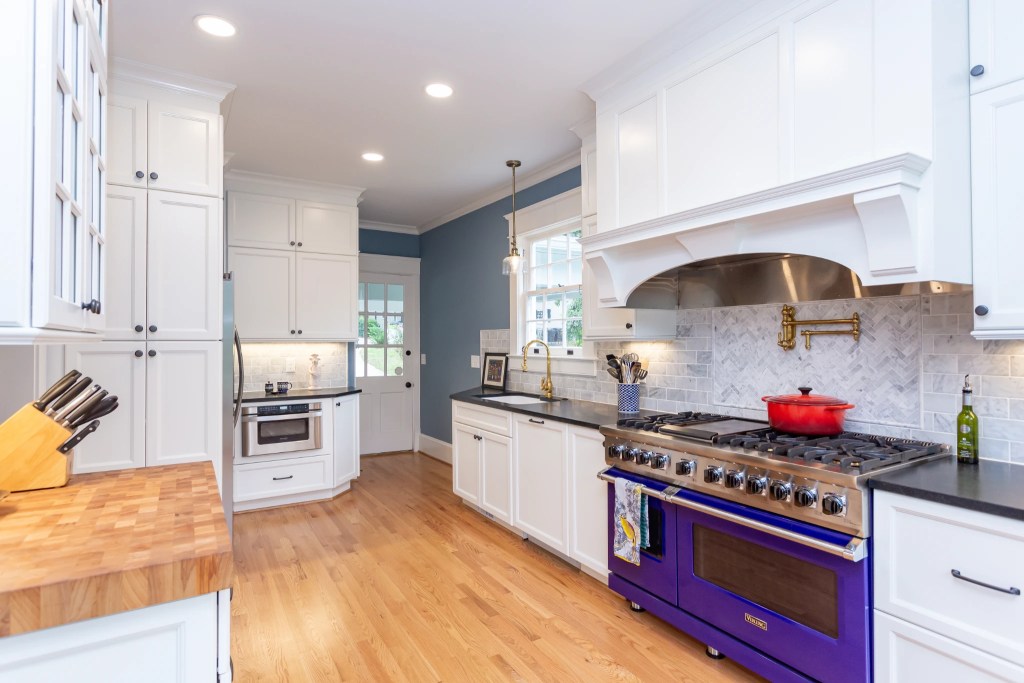
You’ve scrubbed that grout three times this month. It still looks gray. The laminate near the sink is lifting at the seam, catching a fingernail every time you reach for the faucet, and the cabinet door on the end has needed a little lift-and-push to close flush for so long that your hand just does it automatically now. Mop the floor on a Saturday morning and by afternoon it looks like you didn’t bother. There’s a specific kind of exhaustion that comes from a kitchen that always looks dirty even when it’s clean, and if you’ve stopped inviting people into the kitchen while you cook, that’s worth noticing. It changes how your home feels to share it. For homes in Northern Denver suburbs built in the 1980s and early 1990s, original surfaces are now 30 to 40 years old. That’s not a cleaning problem. That’s material science. Laminate, grout, and vinyl were never meant to go four decades. But there’s a distinction worth making: cosmetic aging is one thing, and structural aging is another. A countertop that’s peeling at the edge is frustrating. A countertop that’s lifting because moisture has worked into the substrate, or a floor that feels soft underfoot near the dishwasher, is telling you something bigger is happening underneath the surface. Both are reasons to act, one is about dignity, and one is about damage. If you’re curious what a kitchen on the other side of all of this looks like, the real kitchen transformations in the portfolio are worth a few minutes of your time.
Sign #4: The Kitchen Can't Keep Up With How Your Family Actually Lives Now
This one tends to hit differently, because it’s not really about the kitchen, it’s about your family. The kitchen you have was designed for a version of your household that may not exist anymore. Maybe you had two kids and now you have four. Maybe someone started working from home and eats lunch standing at the counter because there’s simply nowhere to sit. Maybe your teenager parks at the island to do homework, but the island is narrow and always covered in something, so it doesn’t quite work and everyone ends up a little frustrated without knowing exactly why. Or you used to love having people over and now you quietly don’t, because the kitchen is cramped and the flow is wrong and hosting feels like a logistical problem instead of something fun. Communities across Northern Denver and the Front Range have grown considerably, and families have often grown right along with them, into homes that were built for a smaller, quieter version of daily life. The kitchen is where mornings happen, where kids land after school, where weekends actually feel like weekends. When the space actively works against those rhythms, you feel it constantly, in ways that are hard to articulate but impossible to ignore. This isn’t about wanting something prettier. It’s about a kitchen that keeps getting in your way. That’s exactly why the design-build process starts with a real conversation about how you live, before a single drawing is made.
Sign #5: You've Started Dreading the Room Instead of Enjoying It
Here’s the one that’s hardest to admit: you’ve stopped wanting to be in there. Not because you’re lazy, not because you don’t care about cooking, but because the kitchen has become a room you endure. You order takeout more than you planned to this week. You feel a quiet sense of relief when dinner is finally done and you can leave. The idea of hosting makes you tired before anyone’s even been invited. People tend to wave this off with ‘it’s just a kitchen,’ but that’s exactly backward, the kitchen is usually the most-used room in the house, the one that sets the tone for mornings, weekday evenings, and slow weekend breakfasts. When it stops feeling like yours, you feel that in ways that are hard to articulate. You’re not being dramatic. You’ve just been patient for a long time. That feeling is data. It’s telling you something, and it’s worth paying attention to before another year quietly passes. If you’re curious about what a kitchen remodel actually involves, it’s a lot more about how you want to live in that room than it is about countertop samples.
A Note on Permits and Local Codes in Northern Colorado
One thing worth knowing before you get too deep into planning: how Colorado building codes work at the local level means there’s no single statewide rulebook. Whether you’re in Westminster, Thornton, Broomfield, or Arvada, your municipality sets and enforces its own requirements. That matters for a kitchen remodel because scope determines whether a permit is in play. Swapping hardware and repainting? No permit needed. Moving a wall, adding an electrical circuit, relocating a drain, or upgrading ventilation? Almost certainly yes. None of that should scare you off, it just means those pieces need to be sequenced correctly from the start. When you work with a licensed design-build team, permit coordination is part of the job, not something that surfaces as a surprise three weeks in. It’s handled, documented, and closed out properly so your project is on record the way it should be when it matters, whether that’s a future sale or a homeowner’s insurance question. Consider this a heads-up, not a warning. Most of what makes a kitchen genuinely better does involve some permit work, and that’s actually a good sign, it means the changes are real.
Ready to Stop Adapting?
Recognizing these signs is genuinely the hardest part. It means you’ve stopped dismissing the frustration and started taking it seriously, and that’s worth something. From here, the only next step is a conversation, not a commitment. No drawings, no contracts, no pressure to decide anything on the spot. The team at Christie’s Design Build starts every project by listening to how your family actually lives and what you want your kitchen to feel like. That’s it. If you’re ready to finally put words to what’s been bothering you, reach out to start a conversation. It costs nothing, and it might be the most relieving thing you do all week.
H2 FAQ Heading
How do I know if I need a full remodel or just a few updates?
If you’re nodding along to multiple signs from this list, layout that fights your family, storage that stopped working years ago, surfaces past their lifespan, a kitchen that just doesn’t fit how you live anymore, that’s usually telling you something beyond a surface swap. Replacing a countertop or painting cabinets can freshen a room that’s structurally sound and well-designed. But when the problems are systemic, cosmetic fixes tend to disappoint because they don’t change the underlying experience. A quick conversation with a design-build team can help you figure out which category you’re in without committing to anything.
How long does a kitchen remodel take in Northern Denver?
Active construction on a full kitchen remodel typically runs somewhere in the range of six to twelve weeks, depending on scope. What surprises people is everything that happens before the first cabinet comes down, design, permitting, and material lead times all add to the overall calendar. Planning earlier than feels necessary almost always pays off. The families who feel least stressed during a remodel are the ones who gave themselves runway upfront rather than trying to compress the timeline at the end.
What does a first conversation with Christie's Design Build actually look like?
No pressure, no obligation, that’s not just a tagline, it’s genuinely how it works. The first conversation is about your kitchen: how you use it right now, what’s been frustrating you, and what you’d want it to feel like on the other side. There’s no pitch, no hard close, no estimate waved in front of you before you’re ready. It’s just a chance to talk through what’s been nagging at you and get some clarity on what’s actually possible.
Can I stay in my home during a kitchen remodel?
Most homeowners do, and with a little planning it’s very manageable. Setting up a temporary kitchen, a microwave, a coffee maker, a cooler for basics, handles the practical side for most families during construction. The team works to sequence the project in a way that minimizes how much your daily routine gets disrupted, and knowing what to expect week by week makes a big difference in how the whole experience feels.
Will a kitchen remodel actually add value to my home?
Kitchen remodels consistently rank among the highest-return renovation projects, and that holds true in the Northern Denver market. But resale math isn’t usually why families reach out to us. The more honest answer is that the value shows up every single morning, in how the room feels at 7 a.m., whether hosting feels like something you look forward to or something you dread, and whether the kitchen is finally working with your family instead of against it. Equity is a nice side effect. Daily quality of life is the real return.
If these questions sparked more, you’ll find more answers to common remodeling questions on our FAQ page, it’s a good next stop if you’re still in the figuring-it-out stage.